Daily Recap of IJCAI-ECAI 2026 and the Summer of AI in Bremen
Thursday, 20 August, marked the penultimate day of IJCAI-ECAI 2026. The programme featured an impressive lineup of Early Career Spotlight Talks, major invited presentations, scientific award ceremonies, interactive challenges, live demos and public outreach events across the city.
Highlights included Tinne Tuytelaars’ keynote on computer vision and Jiajun Wu’s Computers and Thought Award lecture on physical and visual intelligence. The day concluded with a vibrant Student Reception, celebrating the next generation of AI researchers.


“It doesn’t sound very fancy,” admitted Prof. Tinne Tuytelaars, KU Leuven, at the start of her keynote, Good Visual Representations: Easier Said Than Done.
Despite the popular belief that AI has mastered “seeing”, she argued that teaching computers to truly understand images remains far from solved.
Today’s vision models can easily tag objects in a photo, but they struggle with real-world context such as spatial arrangements, depth and fine details. When systems rely mostly on text descriptions, these critical visual subtleties can get lost.
Tuytelaars urged researchers to look beyond simple object recognition. True visual understanding requires more than recognising and naming objects in a frame; it also demands the ability to capture complex configurations and structural relationships accurately.
She concluded that solving these core challenges is essential for building flexible, robust and trustworthy AI systems.


Following the theme of visual structure, IJCAI 2026 Computers and Thought Award winner Prof. Jiajun Wu, Stanford University, delivered the keynote Building Visual and Physical Intelligence Through Code.
Wu argued that while much of computer vision treats scenes as flat arrangements of pixels, AI must learn to see the physical world as it really is: “Scenes are composed of objects; objects possess their own geometry, texture, material, and physical properties.”
Drawing on research across computer vision, generative AI and robotics, Wu showed how knowledge from physics and computer graphics can guide neural networks to infer these deeper properties directly from raw data, even with limited 3D training data.
By teaching models to perceive intrinsic geometry and material traits, his work paves the way for AI that does not just look at pictures, but better understands and interacts with the physical world.

The IJCAI-ECAI 2026 Early Career Spotlights (ECS) continued on Thursday. Designed as an invited speaker programme, ECS highlights exceptional early-career researchers who have already made significant contributions to artificial intelligence and show strong promise for impactful future work.
Thursday’s presentations included Dr.-Ing. Zhao Ren, University of Bremen / Cognitive Systems Lab, and Mohammad Rostami, University of Southern California / USC Information Sciences Institute.
In her talk, ‘Human-Centred Trustworthy AI for Digital Health: Sensing, Understanding, and Empowerment,’ she explored how human-centred, trustworthy AI can be developed for digital health – from sensing relevant signals and interpreting them to supporting and empowering users.
On Thursday, attendees heard from the winners of two of this year’s three IJCAI Distinguished Paper Awards, which recognise some of the most outstanding research presented at the conference.
IJCAI-ECAI 2026 Programme Chair Prof. Diego Calvanese, Free University of Bozen-Bolzano, presented the second Distinguished Paper Award to Yurun Gu, Télécom SudParis / Institut Polytechnique de Paris, for the paper Tuple Inconsistency Measures: Toward Explaining Query Answers, authored by Yurun Gu, Badran Raddaoui, Yue Ma, Aikaterini Tzompanaki and Nicole Bidoit.
Read the paper: https://ijcai-preprints.s3.us-west-1.amazonaws.com/2026/7822.pdf
The third Distinguished Paper Award went to StreamTimer: Efficient Inference for Long-Context Time Series Transformers, by Xiyu Meng, Yuhan Wu, Canran Xiao, Yabo Dong and Duanqing Xu.
Read the paper: https://ijcai-preprints.s3.us-west-1.amazonaws.com/2026/2468.pdf


Throughout the day, attendees engaged with demonstrations and challenges, while the IJCAI-ECAI 2026 Exhibition Area remained active as a hub for academic-industry exchange and technical showcases.
The day concluded with the conference’s Student Reception in Bremen’s historic old harbour. The evening connected first-time attendees and early-career researchers, fostering the peer networks and collaborative spirit that will shape the future of AI.
It marked the final social gathering of IJCAI-ECAI 2026 and was organized by Local Social Chairs Dr. Katalina Kopka, University of Bremen, and Prof. Dr. Klaus Eickel, Fraunhofer MEVIS and Bremerhaven University of Applied Sciences.

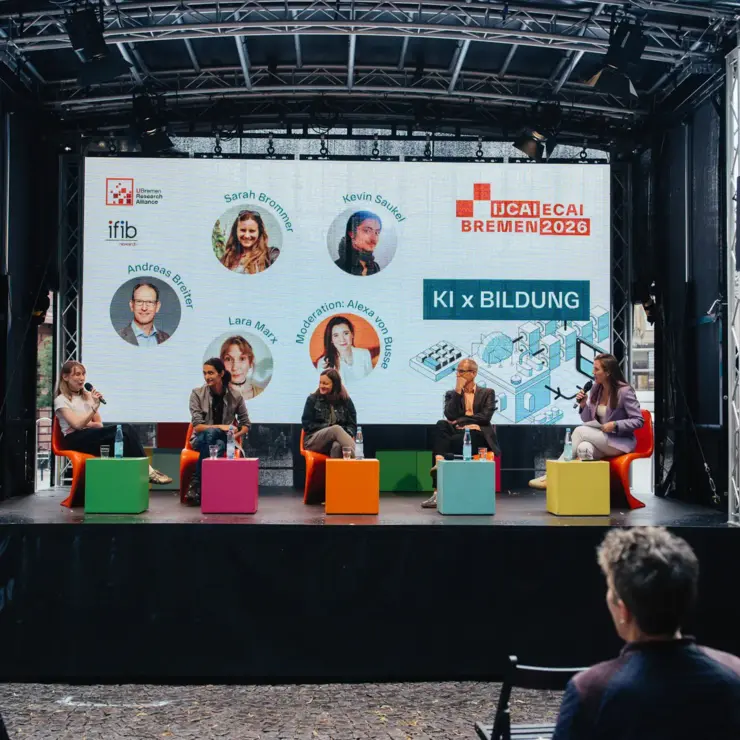

As part of the Summer of AI in Bremen, Thursday’s AI Lounge on Domshof brought the discussion around artificial intelligence directly into the city, this time focusing on AI in Education.
Organised by Institut für Informationsmanagement Bremen GmbH (ifib), the German-language discussion brought together apprentice Lara Marx, student and developer Kevin Saukel, Professor of Applied Linguistics Sarah Brommer, and Professor of Information Management Andreas Breiter.
They explored how AI is transforming learning, teaching and knowledge assessment. The discussion highlighted the growing importance of critical thinking, interdisciplinary collaboration and responsible AI use.
A key takeaway: AI is already part of everyday education in Germany, but its integration remains largely unstructured. Rather than restricting AI, participants emphasised the need for stronger digital and AI literacy, clear guidelines and new approaches to teaching and learning.
The audience also raised questions about technological sovereignty, ethics, democratic knowledge and the reliance of Bremen schools on AI tools, software and hardware provided by major U.S. technology companies.
Contact
IJCAI-ECAI 2026 Local Press Office
The Local Press Office of IJCAI-ECAI 2026 coordinates press relations for the conference in Bremen. It is supported by the U Bremen Research Alliance, the German Research Center for Artificial Intelligence (DFKI), and the German Informatics Society (GI), as well as the Publicity Chairs Prof. Dr. Ralf Möller (University of Hamburg, German Informatics Society) and Prof. Dr. Rolf Drechsler (University of Bremen, German Research Center for Artificial Intelligence).
As the central point of contact for the media, the Press Office provides communications support for IJCAI-ECAI 2026 and is available to media representatives from Bremen and throughout Germany for inquiries both now and during the conference.
Media inquiries: press@2026.ijcai.org

About the U Bremen Research Alliance
The U Bremen Research Alliance brings together the University of Bremen and thirteen non-university research institutions from all four major German science organizations—Fraunhofer Society, Helmholtz Association, Leibniz Association, and Max Planck Society—as well as the German Research Center for Artificial Intelligence (DFKI). Together, these partner institutions shape a coordinated space for research, infrastructure, and innovation—“from the deep sea to outer space.”
Cooperating in U Bremen Research Alliance:


