On Monday, the workshop and tutorial program of IJCAI-ECAI 2026 came to a close, while the transition to the main conference began. As workshop participants said goodbye to their respective research communities, many more international guests were already arriving in Bremen. The program featured 13 workshops and ten tutorials, as well as the diversity event “Global South AI.” Another focus of the day was the Doctoral Consortium for early-career researchers.
The Doctoral Consortium brought together 17 accepted extended abstracts from twelve countries, twelve experienced mentors, and three panelists. Early-career researchers had the opportunity to present and discuss their work, explore career paths, and build connections within the international research community.
The open Career Panel with Prof. Anthony Cohn of the University of Leeds, Prof. Toby Walsh, and Prof. Dr. Michael Thielscher, both of UNSW Sydney, addressed topics including moves between academia and industry, the growing pressure on the academic peer-review system, and the use of AI in peer review. Prof. Walsh emphasized that only a few career decisions are truly irreversible, and that taking calculated risks can pay off.
The panel also discussed the rising number of academic submissions. Prof. Anthony Cohn warned against “salami slicing,” where research projects are divided into the smallest possible publication units, potentially reducing quality. Prof. Dr. Michael Thielscher noted that the use of large language models in peer review has so far produced poorer results than human review. The panelists also encouraged early-career researchers to become involved in the academic community early on, for example as reviewers or workshop organizers, and to speak up on issues of safety and ethics in conversations with policymakers, the media, and the public.


In the evening, Prof. Toby Walsh delivered the public IJCAI-ECAI 2026 AI Lecture, “The AI Race,” in the Festsaal of the Bremen Parliament. Alexa von Busse moderated the AI Lecture and guided the audience through the evening’s program. The fully booked event, attended by 150 guests, was opened by Bremen’s Senator for Environment, Climate, and Science, Dr. Henrike Müller. She called for a responsible approach to the opportunities and risks of artificial intelligence.
Prof. Dr. Jutta Günther, President of the University of Bremen and Chair of the U Bremen Research Alliance, then highlighted flat hierarchies and a strong culture of interdisciplinarity as particular strengths of Bremen.
In his lecture, Prof. Walsh first used examples from medicine, education, and prevention to show how AI can already create societal value today. Examples included the development of new antibiotics, personalized digital learning tools, and smartphone applications that detect dangerous ocean currents.
At the same time, Prof. Walsh warned against looking for the risks of AI primarily in science-fiction scenarios of a superintelligence running out of control. The more urgent dangers, he argued, are already visible today. These include tech companies launching insufficiently safeguarded chatbots, using copyrighted works to train AI systems without consent, or profiting from AI-generated scam advertisements. Prof. Walsh also called on policymakers to take responsibility. Effective rules and clear accountability are needed to avoid repeating the mistakes already made in dealing with social media.
In the discussion that followed, Prof. Dr.-Ing. Tanja Schultz of the University of Bremen, Prof. Dr. Antonio Krüger of DFKI, Prof. Dr. Ralf Möller of the German Informatics Society, and Prof. Toby Walsh discussed how calls for greater responsibility in AI can be translated into concrete and binding practice.

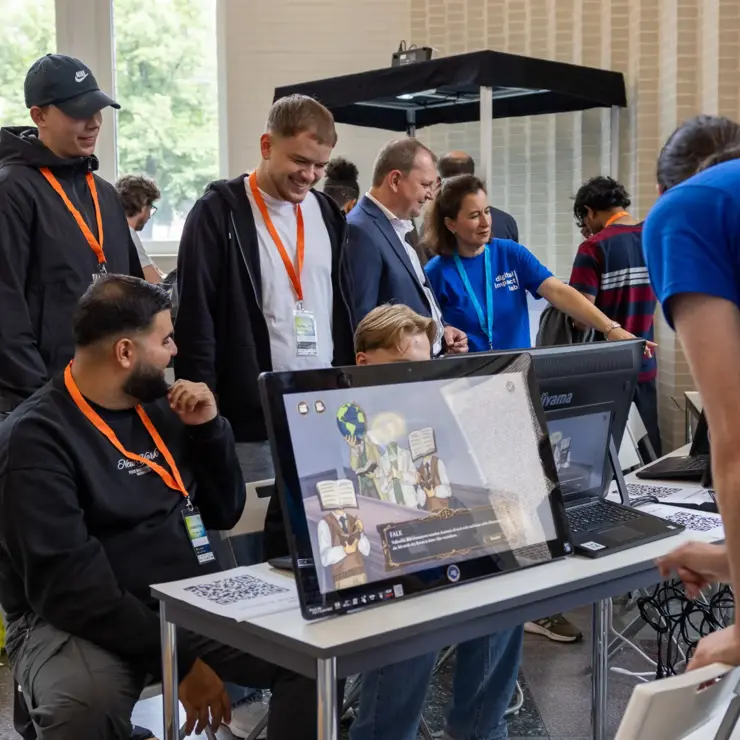

With the AI x Open Lab, a special part of Bremen’s Summer of AI has opened its doors. From August 17 to 22, 2026, the Kassenhalle at Forum am Domshof will become a temporary learning arena dedicated to artificial intelligence. At the opening, State Councilor Maike Frese, State Councilor Karolina Kumar, University President Prof. Dr. Jutta Günther, and Vice President Prof. Dr. Michal Kucera launched the lab together with the Digital Impact Lab and the participating partners.
The common denominator is clear: AI has long been part of everyday life, education, research, and work. This makes it all the more important to build skills, make use of opportunities, and critically assess risks.
The lab is deliberately aimed beyond the international specialist conference. It is open to young people, school classes, trainees, and the broader public. In the mornings, school classes visit the Digital Impact Lab. Registration is available here: https://impact-lab.eu/summer_of_ai/. Daily from 1 to 5 p.m., talks, panels, exhibits, workshops, and hands-on stations offer insights into topics such as AI in medicine, education, the workplace, robotics, learning algorithms, and the responsible use of AI.
The full program is available on the AI x Open Lab website: https://impact-lab.eu/summer-of-ai-programm/


At the end of the day, the international IJCAI-ECAI community came together for the Welcome Reception at the Übersee-Museum Bremen. Surrounded by scientific discoveries, exhibits, and stories of trial, error, and breakthrough, the evening offered space for encounters and conversations, while also marking the shared start of the main conference.
Contact
IJCAI-ECAI 2026 Local Press Office
The Local Press Office of IJCAI-ECAI 2026 coordinates press relations for the conference in Bremen. It is supported by the U Bremen Research Alliance, the German Research Center for Artificial Intelligence (DFKI), and the German Informatics Society (GI), as well as the Publicity Chairs Prof. Dr. Ralf Möller (University of Hamburg, German Informatics Society) and Prof. Dr. Rolf Drechsler (University of Bremen, German Research Center for Artificial Intelligence).
As the central point of contact for the media, the Press Office provides communications support for IJCAI-ECAI 2026 and is available to media representatives from Bremen and throughout Germany for inquiries both now and during the conference.
Media inquiries: press@2026.ijcai.org

About the U Bremen Research Alliance
The U Bremen Research Alliance brings together the University of Bremen and thirteen non-university research institutions from all four major German science organizations—Fraunhofer Society, Helmholtz Association, Leibniz Association, and Max Planck Society—as well as the German Research Center for Artificial Intelligence (DFKI). Together, these partner institutions shape a coordinated space for research, infrastructure, and innovation—“from the deep sea to outer space.”
Cooperating in U Bremen Research Alliance:


