
With several thousand participants from more than 40 countries, Bremen became a meeting place for the international AI research community for one week in August 2026. The International Joint Conference on Artificial Intelligence, held jointly this year with the European Conference on Artificial Intelligence, brought scientific excellence to Bremen while also providing momentum for a broad program focused on transfer, policy exchange, and public dialogue. The event highlighted what Bremen stands for as a hub for science and research: strong research, close connections, and the ability to bring international cutting-edge research into conversation with real-world applications and the wider urban community.

The main conference program took place from August 18 to 21 at Congress Centrum Bremen and was complemented by workshops, tutorials, and public events across the city. The focus was on key future topics in artificial intelligence: agentic systems, multi-agent systems, robotics, safe and controllable AI, and the transfer of scientific findings into practical applications.
Dr. Andreas Bovenschulte, Mayor and President of the Senate of the Free Hanseatic City of Bremen, recognized the conference’s significance for Bremen as a hub for science and technology:
“The IJCAI-ECAI is bringing one of the most distinguished international conferences on Artificial Intelligence to Bremen. The choice for Bremen as the location of this important event is an outstanding acknowledgement for our city as a centre of science and technology. It shows the impact of AI in research, economics and society, and is, furthermore, clear evidence of the excellent conditions Bremen offers to researchers and businesses today.”


Scientific Highlights from the Conference Program
The scientific program of IJCAI-ECAI 2026 covered the broad spectrum of current AI research. The strongest research areas by number of submitted papers included computer vision, machine learning, and data mining. In total, 858 papers were accepted from 6,342 full submissions. The acceptance rate of 13.53 percent underscores the conference’s high scientific standards.
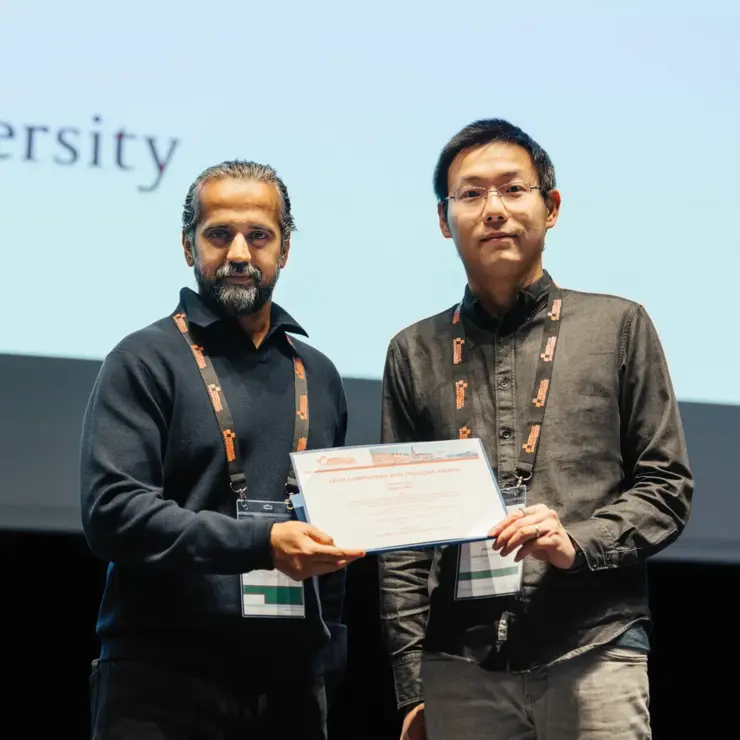
The invited talks and invited sessions provided special highlights. Three IJCAI-26 award recipients were a particular focus: Prof. Nicholas R. Jennings, Loughborough University, received the IJCAI-26 Award for Research Excellence for his fundamental contributions to multi-agent systems, human-agent teamwork, and autonomous agents. Prof. David C. Parkes, Harvard University, received the IJCAI-26 John McCarthy Award and spoke about agent societies and the role of mechanisms, incentives, and institutions in the interaction of intelligent systems. Jiajun Wu, Stanford University, received the IJCAI-26 Computers and Thought Award and demonstrated how computer vision, generative AI, and robotics can help machines better understand geometry, material properties, and physical relationships in scenes.


Session on the EU AI Act
Regulatory issues were also a central focus. In the session on the EU AI Act, Jeroen Delfos of the European Commission explained the transition from legislation to practical implementation. The discussion explored how academia and industry can help shape implementation, including through standardization, codes of practice, expert task forces, and stakeholder consultations. The session highlighted the political dimension of responsible AI: Effective AI governance requires legal requirements, technical expertise, practical standards, and continuous exchange among policymakers, academia, and real-world applications.
The poster sessions and Early Career Spotlight Talks strengthened scientific exchange. Researchers presented their current work in direct conversations, discussed questions, and made new contacts. Early-career researchers were given a visible platform and had the opportunity to discuss their research with the international expert community.


Industry Day and Transfer: Where Research Meets Application
The transfer of AI research into concrete applications was also an important aspect of IJCAI. Industry Day brought together companies, Bremen startups, regional stakeholders, and the scientific community.
International companies such as DeepL, T-Systems, and SAP provided insights into real-time translation, industrial AI infrastructures, knowledge graphs, and agentic systems. At the same time, the strength of Bremen’s innovation ecosystem became clear: Bremen startups such as Count from Above, ellamind, and prokube discussed concrete business and technical challenges directly with the international IJCAI community. The focus was not on traditional pitches, but on open exchange about real-world application questions.
Four guided tours of the exhibition made AI applications tangible for company representatives. The tours on AI x Robotics, AI x Language, AI x Health, and AI x Digital Business Processes led participants to selected research and company booths. There, participants experienced demonstrations and spoke directly with experts. This created concrete connections between research, business, and application.
The networking reception, organized by the Senator for Economic Affairs, Labor, and Ports in cooperation with bremen digitalmedia at the Bremen booth in the exhibition, also deepened the exchange between academia, business, and politics. Representatives from companies, research institutions, startups, and political institutions came together to discuss current developments, potential collaborations, and the transfer of AI into practice.
Kristina Vogt, Senator for Economy, Ports and Transformation, emphasized:
IJCAI-ECAI 2026 highlights what sets Bremen apart as an AI hub: strong research, innovative companies, and direct exchange between research and industry. This is where collaboration with real-world impact takes shape—creating real benefits for business and society.


“Summer of AI” in Bremen: Public Dialogue on AI Across the City
Under Bremen’s guiding theme “Summer of AI,” artificial intelligence was also brought into public discussion during the conference week. The aim was not only to address AI within the international expert community, but also to bring key questions into the broader urban community.
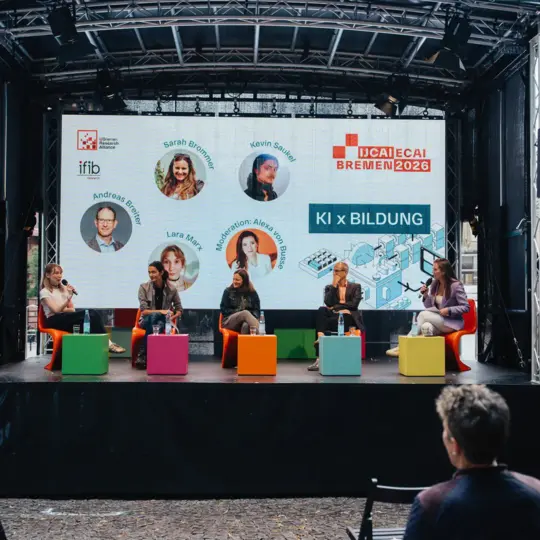
The public panel discussion “New Directions for Safe AI Agents” focused on trust, human-agent interaction, open-source approaches to AI safety, and governance. The discussion made clear that safe AI agents require more than technical solutions. They also need transparency, responsible oversight, and exchange among academia, business, policymakers, and society.
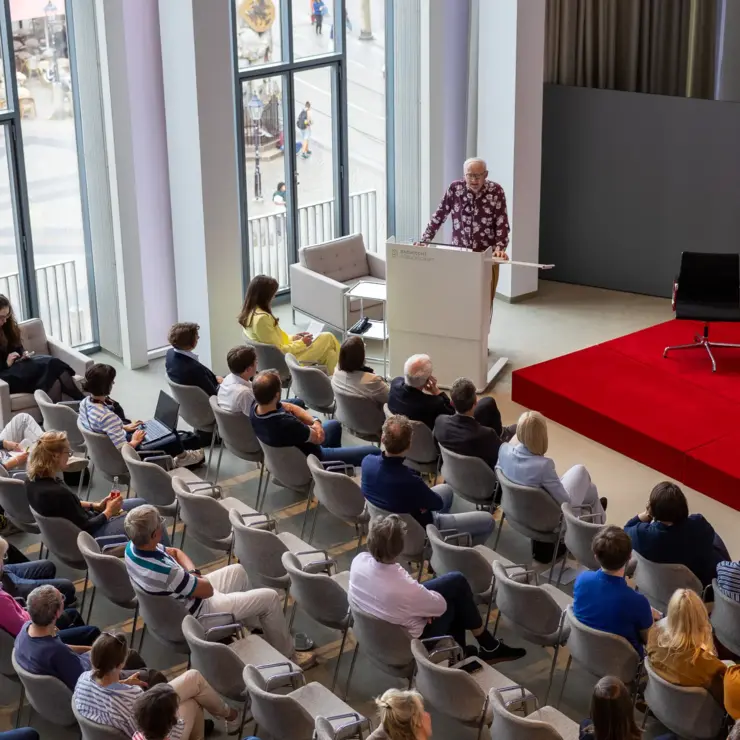
Another public highlight was the AI Lecture “The AI Race” by Prof. Toby Walsh, UNSW Sydney, held in the ceremonial hall of the Bremen State Parliament. Speaking to an audience of 150, Walsh addressed the opportunities, risks, and responsibilities involved in the use of AI.



Dr. Henrike Müller, Senator for Environment, Climate and Science, emphasized the importance of public dialogue:
"Artificial intelligence is already changing our everyday lives, which is why the discussion about it should not be limited to specialists and researchers. Through IJCAI-ECAI 2026’s public outreach programs, such as the AI Lecture, we are bringing international AI research directly into the urban community. Science thrives on open exchange: on clearly communicating the opportunities, being transparent about the limitations, and discussing how we can shape artificial intelligence responsibly."
Four AI Lounges on Domshof
The AI Lounges on the Open Space stage, made possible with the support of the Schütting Foundation and the "Unternehmensverbände im Lande Bremen e. V.", addressed AI-related questions from key areas of everyday life: media, administration, education, and the world of work. Across all topics, the focus was on how AI can be used responsibly in ways that build trust, enable participation, and preserve human decision-making authority. The well-attended events and the many questions from the audience showed the strong interest in clear explanations and open dialogue.


Hands-On AI: AI x Open Lab
The AI x Open Lab at Forum at Domshof made AI accessible and tangible for school groups, apprentices, and the interested public. Talks, panels, exhibitions, workshops, and interactive stations offered insights into AI in medicine, education, the workplace, robotics, learning algorithms, and responsible application. This made AI tangible, understandable, and open to discussion as an everyday topic.


Mural City: Beauty of Science
MURAL CITY added an artistic perspective on science in public space to the “Summer of AI.” Under the theme “Beauty of Science,” eleven new large-scale facade artworks were created and will remain permanent features of Bremen’s urban landscape. International artists explored scientific topics, accompanied by free science talks held in front of the artworks.



From Bremen to the World
IJCAI-ECAI 2026 in Bremen concluded with the Closing Ceremony. At the same time, the focus turned to the upcoming conferences: ECAI 2027 will take place in Athens, Greece. IJCAI 2027 will be held in Kyoto, Japan, from August 7 to 13, 2027, complemented by a satellite event on Hengqin Island, China, from August 15 to 17, 2027.
The conference is moving on, but its central themes remain on Bremen’s agenda: excellent research, transfer into real-world application, and open exchange on how artificial intelligence can be designed to be human-centered, explainable, and beneficial to society. IJCAI-ECAI 2026 showcased Bremen internationally as a strong hub for AI research, real-world application, and responsible dialogue.


More impressions


What Is IJCAI?
The “International Joint Conferences on Artificial Intelligence” is a nonprofit organization founded in California in 1969. It promotes education and research in the field of artificial intelligence through international conferences and the publication of the research papers and educational materials presented there.

Artificial Intelligence in the U Bremen Research Alliance
Through its Artificial Intelligence flagship project, the U Bremen Research Alliance brings together the expertise of its member institutions. The focus is on AI research that combines technological development with societal responsibility.
A particular area of focus is AI in Health. The project also connects to robotics, data science, human-machine interaction, and digital infrastructures.
The flagship project demonstrates how the alliance works: not in parallel, but together. Research institutions contribute their individual strengths and develop shared perspectives from them.
Cooperating in U Bremen Research Alliance:


